




Semantic Layer vs. Ontology: Why AI made both essential?
In the AI era, the difference between a semantic layer and an ontology has become one of the most critical topics in modern data architecture.
For years, organizations focused on ensuring information access, data quality, and consistent metrics. That’s why semantic layers emerged: a way to create a shared language across systems, teams, and analytical tools.
But the rise of AI agents, and enterprise copilots introduced a new challenge: it’s no longer enough to ensure everyone calculates ‘"revenue" the same way. Now we must ensure intelligent systems actually understand what "revenue" means within the context of the business.
That’s why semantic layers and ontologies are taking on complementary roles in AI‑driven data architectures.
Semantic Layer vs. Ontology in summary
A semantic layer defines how data should be consumed through consistent metrics, relationships, and analytical models.
An ontology defines the meaning of business concepts, the relationships between those concepts, and the rules that enable intelligent systems to interpret context and make decisions.
In the age of AI, you can’t have one without the other.
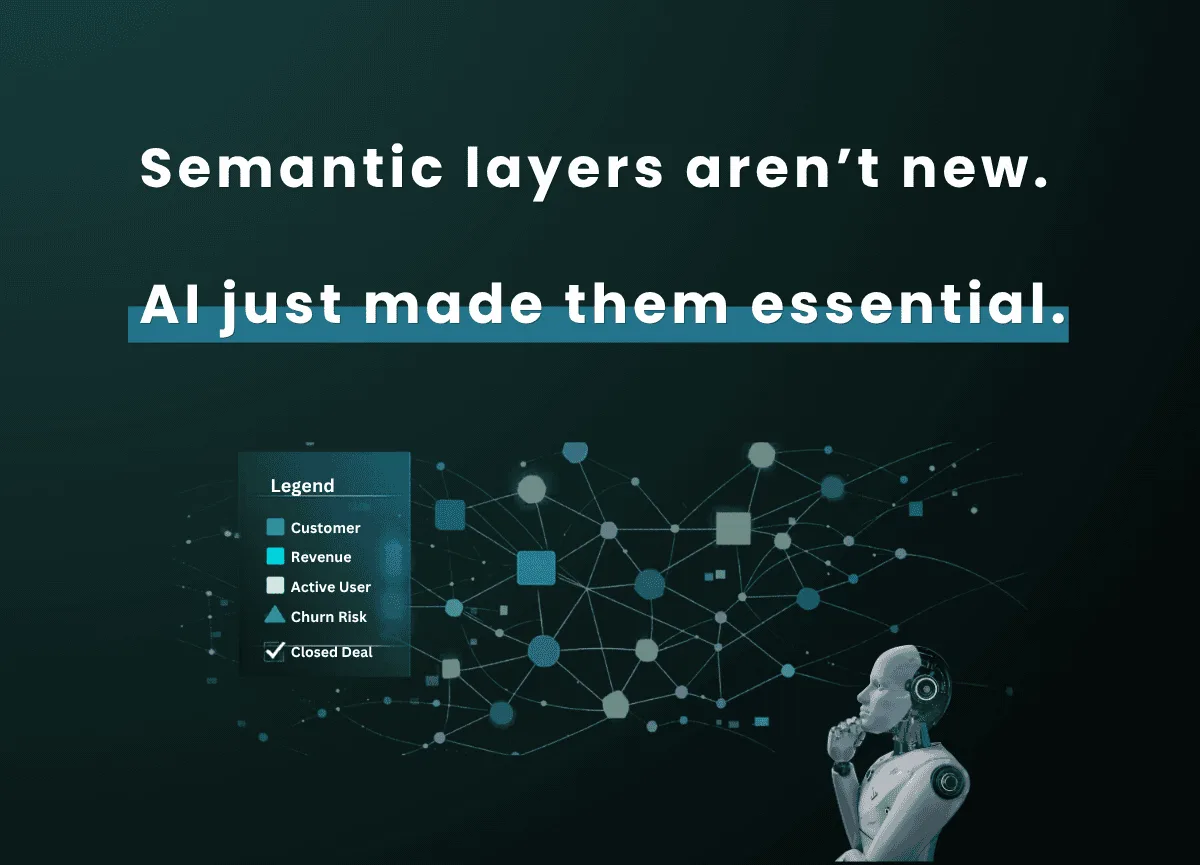
What is a semantic layer and why does it remain essential?
A semantic layer is the layer that brings data closer to the business. Its purpose is to create a consistent representation of information, regardless of the complexity of the underlying systems.
In Microsoft Fabric, semantic models act as a logical description of the analytical domain, including tables, relationships, and metrics that can be consumed by dashboards, applications, copilots, and AI services.
In practice, a semantic layer answers questions such as:
How should revenue be calculated?
What is the official definition of this metric?
Which data should be used?
How can we ensure consistency across reports and teams?
This layer remains fundamental for Business Intelligence, Analytics, and Data Governance. But there is a limitation that becomes increasingly evident as AI evolves from a support tool into a decision‑making mechanism. A semantic layer alone cannot represent all the business context that sits behind the metrics.
Ontology: What is it, and how does it differ from a semantic layer?
Instead of defining only metrics and analytical relationships, it formally models the business domain, concepts, entities, relationships, rules, constraints, and dependencies.
While a semantic layer answers the question "how should I consume this data?", an ontology answers the question "what does this concept mean within the organization?"
This makes it possible to create a shared representation of the business that can be used by people, applications, workflows, and intelligent agents. More importantly, it allows organizations to make explicit the knowledge that usually exists only in the minds of teams.
Who is considered an active customer?
When does a sale count toward a given KPI?
What exceptions exist within a sales process?
What relationships exist between customers, contracts, products, and services?
Historically, these answers were scattered across documentation, internal procedures, and tacit knowledge. The ontology aims to turn them into a formal, reusable structure.
Semantic Layer vs Ontology: The difference in practice
The best way to understand the difference is not through the technology itself, but through a real business problem. In an organization with multiple systems, it is relatively common to find three different definitions for "active customer":
The CRM considers any customer with recent sales activity to be active.
The ERP considers any customer with invoicing in the past twelve months to be active.
The Marketing team considers any contact who has interacted with recent campaigns to be active.
The semantic layer can ensure that each dashboard uses the correct definition for each context. But the challenge appears when an AI Agent receives an instruction that seems simple: ‘"Identify the active customers with the highest churn risk". Before executing the task, the agent needs to know which of the three definitions it should use.
This is no longer a question of metrics. It is a question of meaning.
This is precisely where the ontology adds value: it provides the context intelligent systems need to interpret business concepts the same way an experienced team would.
Why do AI and AI Agents need ontologies?
For the first time, we are beginning to see systems that not only retrieve information, but can recommend actions, trigger workflows, or execute decisions with different levels of autonomy.
Without explicit context, an agent may produce answers that sound plausible but are misaligned with the real business rules. And as these agents begin to operate at scale, small ambiguities can quickly turn into incorrect decisions repeated hundreds or thousands of times.
This is why the conversation around enterprise AI is gradually shifting from models to the governance of meaning.
The real challenge is ensuring that AI understands the business in the way the organization intends.
How does Microsoft Fabric use semantic models and ontologies?
For several years, the semantic model was the primary business abstraction within the Microsoft ecosystem. It was the layer responsible for transforming technical structures into information that analysts and decision‑makers could actually use.
With the introduction of Fabric IQ, a clearer distinction is beginning to emerge between two different responsibilities.
The analytical representation of the data.
The representation of the meaning of the business.
This evolution matters because it directly addresses one of the biggest challenges in enterprise AI: creating a governed source of context that can be shared across users, applications, and intelligent agents.
In practice, this means the architecture stops being only data‑oriented and becomes knowledge‑oriented. The semantic layer remains responsible for delivering metrics, KPIs, and analytical models. The ontology takes on the role of representing concepts, relationships, policies, and business rules.
The result is an architecture that is far better suited for AI Agents, because it clearly separates two different questions:
How to access the information?
How to interpret that information?
We believe this separation will gradually become a common feature of enterprise architectures designed for AI, regardless of the underlying technology.
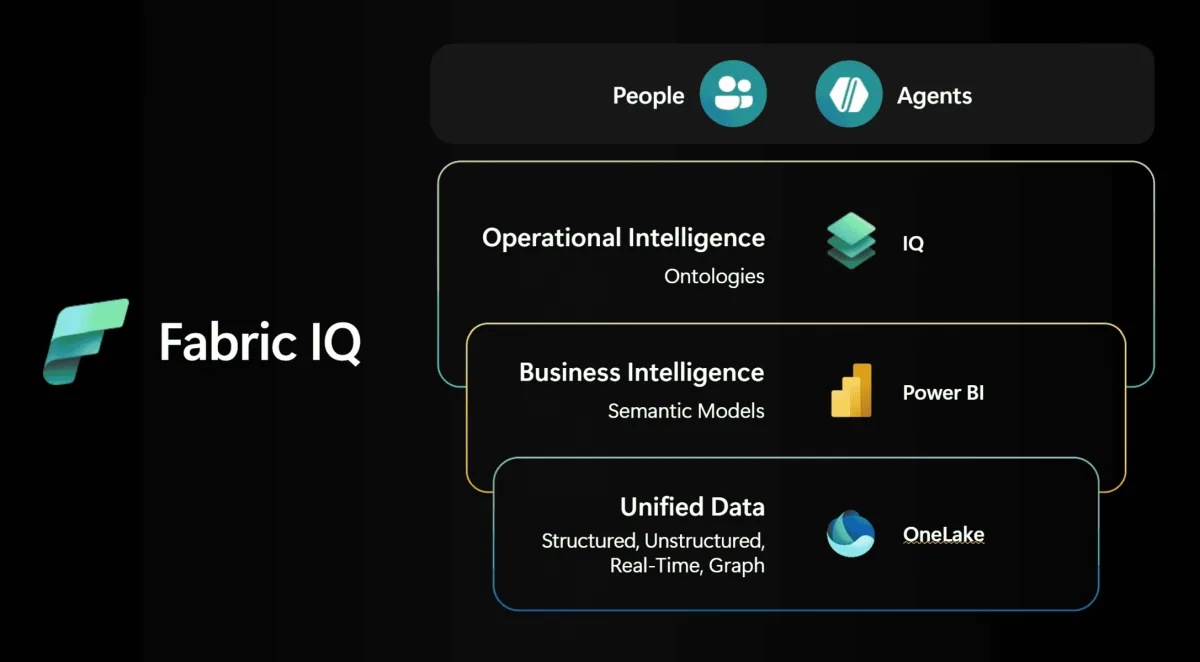
Source: https://learn.microsoft.com/en-us/fabric/iq/overview
What should organizations do to prepare their data for AI?
In our experience, in most organizations the data exists, the dashboards exist, the metrics exist, what often does not exist is a formal and shared definition of the organization’s most important business concepts.
This is precisely why many AI initiatives start by exposing inconsistencies that were already there long before AI itself arrived.
The relevant questions then become:
Who defines critical business concepts?
Where do the business rules live?
How are they governed?
Who validates exceptions?
How do we ensure that an AI Agent interprets the business in the same way a senior team does?
Organizations that answer these questions first will be better positioned to scale AI safely and sustainably.
FAQ: Semantic Layer and Ontology
Are a Semantic Layer and an Ontology the same thing❓
No. The semantic layer provides consistent metrics, calculations, and analytical definitions. The ontology models concepts, relationships, and business rules.
Does an Ontology replace a Semantic Layer❓
No. They are complementary components. The ontology provides context and meaning, while the semantic layer provides governed access to data.
Why does AI need an Ontology❓
Because AI Agents and copilots require explicit context to interpret business concepts, apply rules, and make consistent decisions.
Does Microsoft Fabric support Ontologies❓
The evolution of Fabric IQ points to an architecture where semantic models and ontologies coexist to provide both governed access to data and governed context for AI.
Conclusion
For years, organizations prioritized democratizing access to data. In the coming years, the challenge will be democratizing meaning.
Companies that manage to turn tacit knowledge into governed context will be better prepared to use AI Agents in a scalable, safe, and business‑aligned way.
If your organization has already invested in Data Governance, this is the right moment to assess whether your architecture is prepared not only to answer questions, but to support systems capable of acting on the answers.
Because in the era of AI, competitive advantage gradually shifts from the data an organization owns to the way it defines, governs, and shares its meaning.
Is your architecture ready for AI Agents? Talk to our team of experts for a quick assessment of your semantic layer and data governance.